
How we work
The Invaris method
Our work is structured but not standardised. Each family arrives with its own composition, its own reasons for moving, its own timeline, and its own set of anxieties. What we bring is a way of thinking about the transition that has proven useful across many different situations — and the discipline to hold the whole picture even when specific problems are pulling attention in one direction.
Where it starts
The first conversation
Every engagement begins with a long conversation, usually across two sessions and often with both partners present. Where appropriate — for older children, or for families with adult children whose lives will be affected — we include them as well.
The purpose of this first conversation is not to solve anything. It is to understand what has already been decided, what is still open, what each person in the family is quietly carrying, and what version of the future the family is moving toward. We ask direct questions. We do not offer reassurance we have not earned.
What you leave with
At the end of this stage we produce a written map of the family's situation as we have understood it, with our initial observations about what needs immediate attention, what deserves deliberate attention, and what can wait.
This document is for the family. It becomes the reference point for everything that follows.
Three horizons
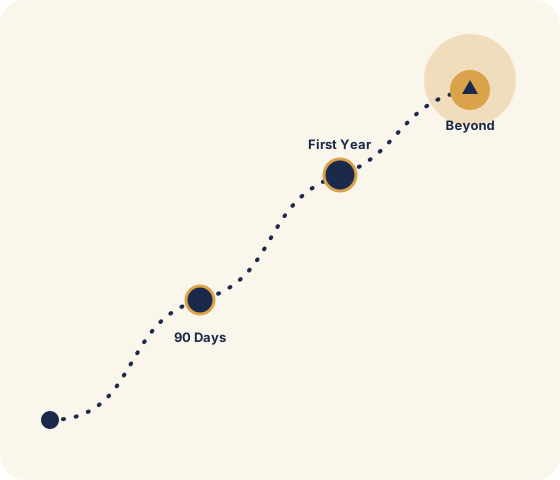
We think about the work across three timeframes
The next ninety days
The irreversible or time-sensitive items: filings with deadlines, structures that must be closed or opened before a particular date, decisions whose sequence matters. Getting these right does not require heroics — it requires knowing what they are and addressing them in order.
The first year
The period in which the family's real footing in the new country is built or not built: professional networks, medical continuity, banking that works, schools that are right for these particular children, and a rhythm of contact with the family left behind that is sustainable rather than performative. It is also when the emotional work most needs to be named, as the initial energy of the move fades.
Beyond the first year
The horizon most families are not thinking about when they move, and most need to within a year of arriving: succession across two jurisdictions, children's long-term education and identity, the following partner's professional trajectory, the question of return held explicitly, and assets restructured for the new reality.
Not every engagement covers all three horizons. Some families arrive with the first horizon already handled and want us for the second and third. We adapt to where the family is.
No referral fees, ever
Our fee comes from the family, and our advice is accountable to the family alone. Where you need counsel we don't accept commissions from anyone we recommend.
Coordination, not replacement
How we work with your other advisors
We do not replace your lawyers, your tax advisors, or your accountants. We insist that you have competent counsel in both jurisdictions and, where relevant, in third countries where you hold assets or ties.
Our role is coordination. We ensure that your advisors in each country are working from the same picture of your family's situation and plan. We attend meetings with them where useful. We translate — in both languages, and in the sense of making one profession's reasoning intelligible to another. We catch the gaps that appear between competent advisors who are each doing their job correctly but not talking to each other.
Where a family does not have appropriate counsel in one or more jurisdictions, we help identify it.
Bilingual working
We work fluently in English and German, in professional and personal registers, and we understand the cultural differences between the two working cultures. A German or Austrian tax advisor and an American estate lawyer are not only speaking different languages — they operate from different assumptions about directness and what a good outcome looks like. We move between these registers as needed.
Discretion
Most of our clients come to us through referral, and most prefer to remain private. We do not publish client names, use testimonials, or discuss ongoing engagements. Our client agreements include reciprocal confidentiality that extends beyond the engagement itself.
Duration
The shape of an engagement
A typical engagement lasts between one and three years, with an intensity that varies across that time.
Year one
The first ninety days are usually the most concentrated, followed by regular structured check-ins and availability for the questions that arise between them.
Year two & three
For families that continue with us, this is lighter — a review cadence and a standing invitation to raise anything that has come up.
Project or ongoing
Some families work with us on a defined project — a specific move, a specific set of decisions. Others engage us as an ongoing function for the international dimension of their affairs. We are direct about what makes sense for each family.
See what beginning looks like
The first contact, the exploratory conversation, fees, and confidentiality — all explained plainly.
Go to first steps & contact